This article is for general information only and is not legal, tax or accounting advice.
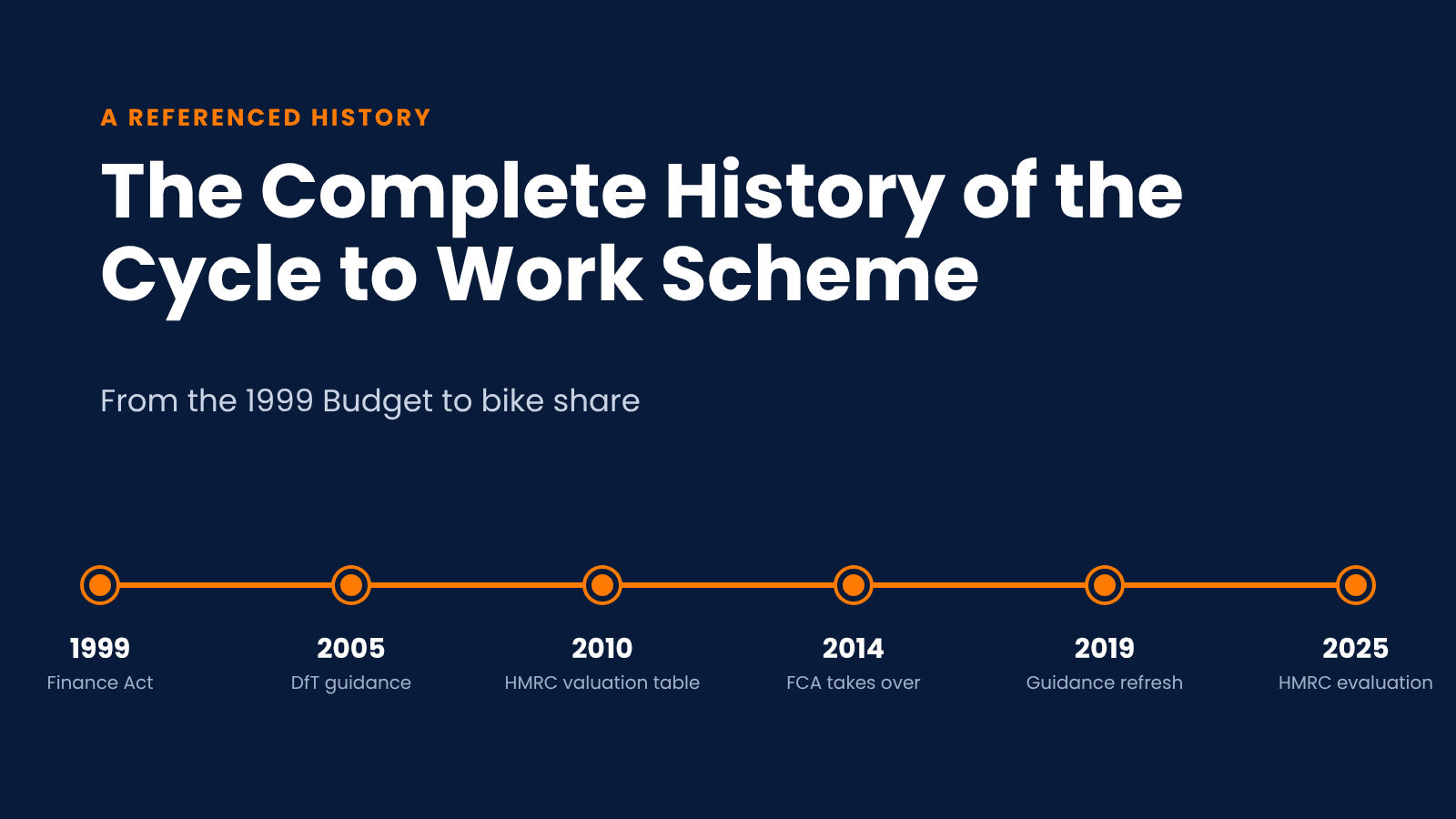
Key dates at a glance
- 1998: Transport White Paper promotes green transport plans
- 1999: Finance Act 1999 creates the exemption
- 2003: Exemption moves to section 244 ITEPA 2003
- 2005: Department for Transport implementation guidance
- 2009: Ireland introduces its own cycle to work tax exemption
- 2010: HMRC end-of-hire valuation table
- 2012: VAT due on Cycle to Work salary sacrifice
- 2014: FCA takes over consumer credit regulation
- 2017: Scheme protected from optional remuneration rules
- 2019: Updated guidance confirms schemes above £1,000
- 2020 to 2022: COVID-19 easement
- 2022: Industry calls for lower-paid and self-employed workers to be included
- 2024: First bike-share offers through the scheme
- 2025: HMRC publishes its evaluation of the scheme; DASH Flex covers all UK bike-share providers; Autumn Budget leaves the scheme unchanged
Where the scheme came from (1998 to 1999)
The scheme began as transport policy. The July 1998 White Paper, A New Deal for Transport: Better for Everyone, encouraged organisations to adopt green transport plans to reduce car commuting, and the Treasury itself aimed to have one by March 1999 [1].
Chancellor Gordon Brown's March 1999 Budget then announced green commuting tax measures from 6 April 1999. Alongside reliefs for works buses and bicycle parking, employers could provide bicycles and safety equipment without a benefit-in-kind charge [2].
Section 50 of the Finance Act 1999 enacted this as section 197AC of the Income and Corporation Taxes Act 1988, from the 1999-00 tax year. It set three conditions, and they remain the core of the scheme today.
First, there must be no transfer of ownership of the cycle or equipment to the employee.
Secondly, the benefit must be available generally to the employer's employees.
Third, the employee must use the cycle or equipment mainly for qualifying journeys, meaning journeys between home and work, or between workplaces.
The word "mainly" was chosen with care. On 6 July 1999, Economic Secretary to the Treasury Patricia Hewitt moved an amendment replacing a stricter "substantial compliance" test, telling the Commons that "there is no intention to withdraw the relief if the employee also uses the bike for private or leisure use" [3]. That has been the test ever since: main use, not exclusive use.
From exemption to scheme (2003 to 2005)
ITEPA 2003 moved the exemption to section 244 from 6 April 2003, with the qualifying journey definition in section 249. The substance was unchanged.
The familiar structure arrived with the Department for Transport's Cycle to Work Scheme Implementation Guidance in June 2005, produced with the Department of Trade and Industry, the Office of Fair Trading (OFT), HMRC and the cycle industry. It explained how employers could pair the exemption with salary sacrifice, the employee giving up part of their gross salary in return for hiring a bike. Because the bike was hired, not sold, any later sale had to be a separate agreement after the hire ended, at fair market value [4][5].
This is also where the much-quoted £1,000 figure comes from. Importantly, it was never a tax limit. It was the ceiling of an OFT group consumer credit licence covering employer schemes up to £1,000 including VAT [4].
Growth and clarification (2009 to 2014)
Ireland introduced a similar exemption for employer-provided bicycles from 1 January 2009, with a €1,000 limit [6].
In August 2010, HMRC addressed what an employee should pay to take ownership at the end of hire. Until then, many schemes had simply used a nominal figure of around 5%. HMRC published a simplified valuation table which put a one-year-old bike at 18% of its original price, or 25% where it cost £500 or more [7]. That table, now at EIM21667A, treats a bike as having negligible value at six years old, which later shaped how many providers handle ownership.
In July 2011, following the European Court of Justice's Astra Zeneca decision (Case C-40/09), HMRC's Revenue and Customs Brief 28/11 confirmed that salary sacrificed counts as payment for VAT purposes. Employers had to account for VAT on Cycle to Work salary sacrifice from 1 January 2012 [8]. The Department for Transport reissued its guidance in October 2011.
On 1 April 2014, consumer credit regulation passed from the OFT to the Financial Conduct Authority (FCA) [9]. Under the FSMA (Exemption) Order 2001, an employer acting as owner can provide cycles worth up to £1,000 without FCA authorisation; above that, the owner of the hire agreement must be authorised.
Protected from salary sacrifice reform (2017)
From 6 April 2017, the Finance Act 2017's optional remuneration arrangements rules removed the tax advantages of most salary sacrifice benefits. Cycle to Work was one of a few exemptions expressly protected. Section 228A ITEPA 2003 lists it as an "excluded exemption", and HMRC's guidance confirms that these exemptions "are not affected by the changes" [10].
The 2019 refresh
In June 2019, the Department for Transport published updated Cycle to Work Scheme Guidance for Employers, produced with HM Treasury, HMRC and the FCA. Announced by cycling minister Michael Ellis during Bike Week, it made clear that schemes above £1,000 are acceptable where the provider holds the necessary FCA authorisation. It also addressed electrically assisted pedal cycles and adapted cycles for disabled riders directly [11][12]. Press coverage widely reported this as removing the £1,000 "cap". The guidance also recorded the scheme's scale: over 40,000 employers and more than 1.6 million commuters, according to the Cycle to Work Alliance.
Vouchers and bike share
Since 2019, most of the change has come from providers rather than from Parliament.
Vouchers are a good example. The 1999 legislation extended the exemption to non-cash vouchers giving an employee the use of a cycle [13], and for most of the scheme's history employees received a voucher or certificate to redeem at a partner retailer. Dash Cycle to Work introduced what it describes as the first voucher-free Cycle to Work scheme. Employees order directly through the platform in a single step, without waiting for a voucher code or losing an unspent balance, and can combine items from several retailers in one order [14].
Bike share followed. HMRC's guidance had already anticipated it: EIM21664 states that where a cycle is provided "via membership with a bicycle share scheme", the main-use test applies to any cycle used under the scheme. In February 2024 Forest launched a Cycle to Work offer for its dockless e-bikes [15], and in August 2024 Lime joined the scheme through a specialist provider [16]. Each covered a single operator. In April 2025 Dash Cycle to Work launched DASH Flex, the first Cycle to Work pass to cover all UK bike-share providers. It allows one employee to ride with operators such as Lime and Forest under a single salary sacrifice arrangement [17].
The pandemic and the present day (2020 onwards)
The COVID-19 pandemic tested the qualifying journeys condition as many employees stopped commuting. Under a temporary HMRC easement, employees who received a cycle on or before 20 December 2020 did not need to meet the qualifying journeys condition until after 5 April 2022 [18].
Ahead of the November 2025 Autumn Budget, reports suggested the Government would restrict high-value purchases. On Budget day, 26 November 2025, the Treasury confirmed nothing had been announced on Cycle to Work and no policy change would be made [19]. Pension salary sacrifice was not so lucky, as the same Budget capped its National Insurance relief at £2,000 a year from April 2029 [20].
Other tax changes have shifted the numbers too. From 6 April 2025, the employer National Insurance rate rose from 13.8% to 15% [21], which increased the employer's saving on every pound sacrificed. Scotland also sets its own income tax rates, from 19% to 48% in 2026/27, so riders in Scotland save different amounts from those elsewhere in the UK [22].
Does the scheme work?
HMRC commissioned Ipsos to evaluate the scheme, with fieldwork in 2022 and the report published in April 2025. It found that 39% of users had not cycled to work before joining but did afterwards, and that 59% of these new cycle commuters would otherwise have travelled by car or taxi. Higher-rate taxpayers made up 30% of users, compared with 16% of all UK taxpayers [23].
A study commissioned by the Cycle to Work Alliance and published in October 2025 estimated that 209,000 employees used the scheme in 2024/25 and that over two million people have used it since it began. It put the scheme's contribution to the UK economy at £573 million a year [24].
Who is left out
Not everyone can use the scheme, however. Salary sacrifice cannot take an employee's pay below the National Minimum Wage, which limits or rules out participation for many lower-paid workers. Self-employed people are excluded altogether, because the exemption depends on an employer providing the cycle. In May 2022, the Cycle to Work Alliance coordinated a letter to the Chancellor, backed by the Co-op, the Federation of Small Businesses and British Cycling, asking for both groups to be given access. The Alliance's research found that one in three employees who had not joined said their income was too low [25].
Conclusion
Overall, the law behind the Cycle to Work scheme has changed surprisingly little. The three conditions written into the Finance Act 1999 (no transfer of ownership, general availability and main use for qualifying journeys) are the same three conditions found in section 244 ITEPA 2003 today. Nearly everything around them has changed, though. Salary sacrifice, end-of-hire valuation, VAT, consumer credit rules and the official guidance have all been reworked over time, and more recently voucher-free ordering and bike share have changed how people actually get a bike.